Things happened really quickly in February. The combination of Black History Month and the commemoration of the 60th year since my brother, Michael Jones, Lance Newman, Ronald Deskins and Gloria Thompson desegregated schools in Arlington created a lot of interest in Halls Hill and the book.
Local television station, WDVM-TV contacted Michael and I and here is the interview.
Thanks to Kiona Dyches, the reporter who had an interest to share the story of our community. It really was more than a neighborhood.
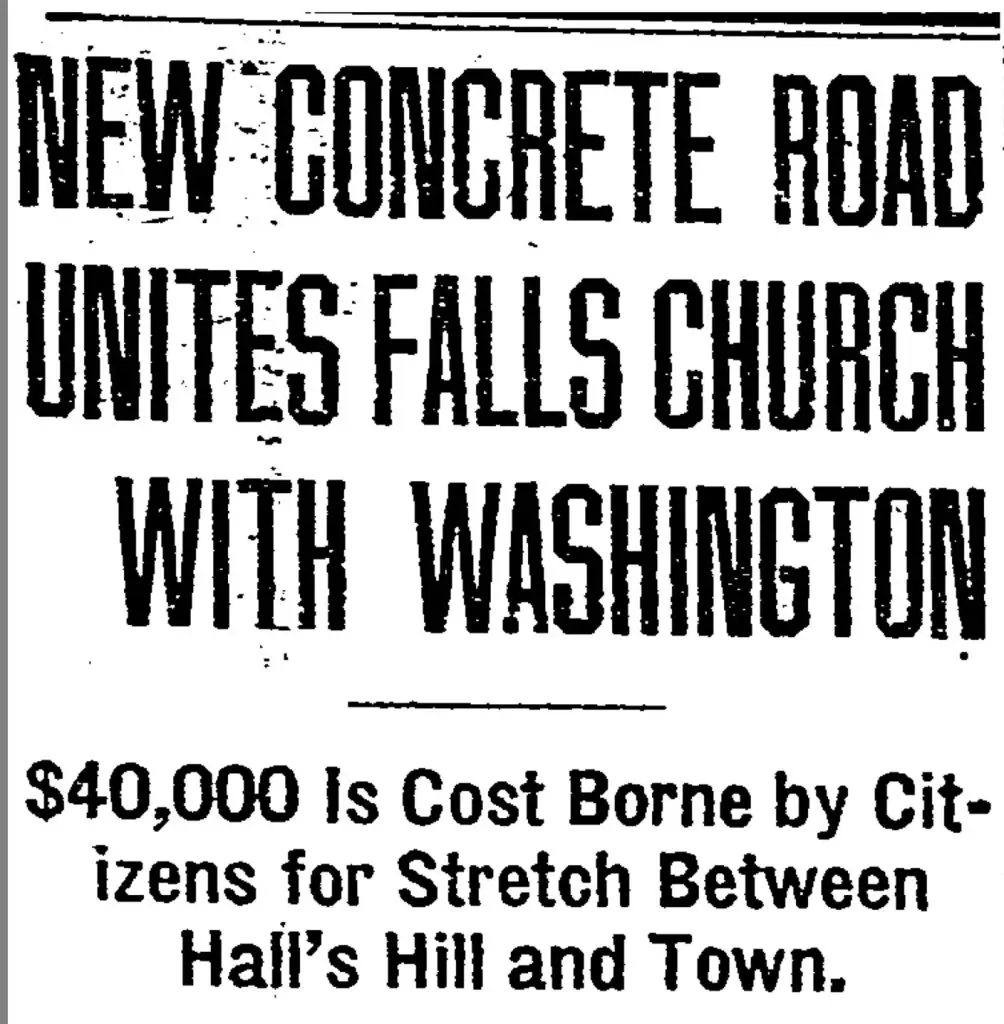
Lee Highway is Extended from Halls Hill to Falls Church
I interviewed my dad in 2012 about life on Halls Hill as he remembered it as a young child. One of the things he explained was a big deal was the extension of Lee Highway from Halls Hill to Falls Church. Although he was only around 5 years old, looking back he remembered that for the first time people could drive cars to what was then a pretty rural area.
Prior to the highway extension most people traveled by horse to Falls Church, the Chesterbrook area of McLean, and the what is now the Tyson’s Corner area. When 40 residents of Falls Church endorsed the $40,000 bank loans (from two Georgetown banks) for the state to extend the road, it was proof of how important increasing access to the community was for it’s future growth and relative importance in the area. Arlington paid the interest on the loan.
Lee Highway had been extended from Cherrydale to Halls Hill many years before, making the allowing the neighborhood to thrive from a population growth and for entrepreneurs operating businesses on the Highway. The road was eighteen feet wide with one lane in either direction. It was extended 1.5 miles from Halls Hill to Falls Church. The work was completed on December 23, 1923 but the road was not opened for use until January 14, 1924.
It was during this period that Halls Hill and the route to the community via Lee HIghway became important for the safety of African Americans. Sometimes when traveling from DC to Halls Hill, African Americans were concerned because of the thriving Klu Klux Klan organization in Cherrydale. Many people experienced whites chasing them via car through the Cherrydale area, with taunts and threats of violence for passing through their community, especially after dark. But once the chase reached Culpeper Street, (the only way in or out of Halls Hill at the time) and Fire Station 8, they were safe.
The Rev. James Eugene Browne was the assistant pastor of Mount Salvation Baptist Church when Rev. N.R. Richardson was the senior pastor. Rev. Browne and his wife, Hazel initially resided in the Cherrydale community in when they came to Arlington from Texarkana, TX.
Rev. Browne spoke about the racism and influence of the Ku Klux Klan in Cherrydale in the 1930’s in the period when they first came to this area.
The family eventually moved to 2011 North Culpeper Street in the Halls Hill neighborhood. They had two children, Lillian Browne Fernanders and James E. Browne, Jr.
Rev. Browne often told the story of the Halls Hill streets not being paved when they initially moved to the neighborhood. This caused his shoes and pants to be dusty and dirty if he walked to the church. As a result he drove each week, even though Mount Salvation was only a block away.
Rev. Browne led youth groups at Mount Salvation in their activities with the Northern Virginia Baptist Association, taking them on many trips across the state and southeast region for conferences and events. Mrs. Browne was the manager of the Langston elementary school cafeteria for many years, and she also ran the summer playground programs for Arlington Recreation.
Rev. Browne was a former president of the John M. Langston Citizens Association, the neighborhood civic organization on Halls Hill. He was also very active in the Arlington NAACP, serving in leadership roles for many years, including president during the fight for school desegregation in the late 1950’s.
What memories do you have about Rev. and Mrs. Browne from Langston elementary school, Mount Salvation church or just in the neighborhood?
For as long as I can remember, there has been a debate about Halls Hill versus Hall’s Hill among community members. I made a self-publishing decision that may irritate the grammar police. I am aware that the word should have an apostrophe to show possessiveness. However, on this project I decided to follow the direction of the older generation in our community.
The county government funded community art projects in the early 2000s. Our neighborhood project, Memory Bricks/The Family, was created by Winnie Owens-Hart in 2004 as the welcoming gateway to our neighborhood.
During the design concept stage, the John M. Langston Citizens Association held a brainstorming session, led by Ms. Hart, with the community. My dad and I attended with about 50 other residents. The question was raised whether to include the apostrophe or not. The overwhelming consensus was to eliminate it. I continue to honor that decision with this book and the Halls Hill project. That’s how I think my daddy would have liked it.
What are your thoughts? Do you write Halls Hill with or without the apostrophe?
Halls Hill was inhabited by former slaves and some free black people following the Civil War. Although black people who were slaves in captured Union territory became free after the Emancipation Proclamation issued by President Lincoln in 1863.
Halls Hill was known as “Halls Plantation,” prior to the Civil War. Halls Hill was named for its location—a high hill in what had initially been Alexandria County—and the original property owner, Basil (also spelled Bazil, in some writings) Hall. Hall, a white man born in 1806, purchased 327 acres of land in 1850 for approximately $5,000 and started a plantation. Like most plantation owners in Virginia prior to the Civil War, Hall owned slaves to provide manual labor to work the land and animals.
The Halls were well known for the brutal way they managed their slaves. One of their female slaves, Jenny Farr, reached her breaking point with Hall’s wife, Elizabeth. She threw her in the hearth, murdering her. Jenny was convicted and hanged on February 26, 1858.
Hall remarried, and the plantation thrived until the South addressed the issue of slavery. Virginia had voted to secede from the union, and although Hall voted against secession, he did not fare well during the Civil War. His property was the site of many Confederate and Union troop skirmishes, and in August 1861, he fled his home. The Union Army used the site as a camp for the remainder of the war.
Following the war, Hall returned the plantation, which was staffed by laborers. Many of them were freed slaves who lived in rented shacks on the plantation. Hall continued his cruel treatment of the black people who worked on the plantation and was eventually charged with assault and battery and inhuman treatment of black people in his employ in 1866. In the post–Civil War era, the courts in Virginia would not hear any cases brought against white people if black people were the persons harmed. The federal government had established a military court with a provost marshal to adjudicate these cases. Despite sufficient evidence, Hall’s attorney convinced President Andrew Johnson to intercede in the matter. Johnson directed the military provost to drop the case and have it addressed in civil court. Of course, no court in Virginia would proceed with the case, so Hall was never punished.
Hall attempted to sell his land as one lot in 1872 but was unable to make a deal. He then began to sell smaller lots of property to white men. These men established farms using black laborers, who rented shacks on their respective farms. Black people inhabited Halls Hill, but it wasn’t until November 9, 1881, that black people were able to purchase land. Hall sold one acre of his land to Thornton Hyson and Charles W. Chinn for $108 and continued to sell his land to black people until he died in 1888. One other black man, a former slave named Moses Jackson, owned property on Halls Hill in the 1880s. Jackson’s owner gave him the land on what became part of Halls Hill upon his freedom.
There are many descendants of the Hyson, Chinn and Jackson families that lived in Halls Hill for generations. A few still reside there now.
Did you know the about these black men that purchased property to start building this neighborhood?
Bordered by George Mason, Glebe Road, and Lee Highway A closely knit community where Black folks lived and played From Culpeper to Emerson; numbered streets in between Proud African-Americans tied to no one’s apron strings
A beautiful oasis surrounded by a Jim Crow County A community where Black folks owned their property Mt. Salvation Baptist, Highview Park, and Calloway Three spiritual havens where we often went to pray
A neighborhood surrounded by the country club’s elite Yet, Black folks lived a simpler life without outside conceit A wall divided neighborhoods experiencing neglect The county looked the other way, showing no respect
Many businesses established by our own entrepreneurs May not have been wealthy but neither were they poor Federal, state, and local workers lived on every street Hicks and Allen’s general stores, we had our own elite
Our Citizens Association was very much concerned Held monthly meetings and kept residents informed Joined Martin Luther King in the cause for civil rights Marched for integration, put an end to racial fights
Langston Elementary is where we earned good grades Our dedicated teachers ensured that rules were obeyed When the schools integrated, our parents did not tolerate Their children at white schools being treated second-rate
Cameron playground where scuffles would break out Danced to the latest tunes were all teens thought about Hanging on the corner under dimly lit street lights Played “Simon Says” during those hot summer nights
Dressed up in the latest fashions was always the rage House parties attended by those under drinking age Frequented Suburban Night or Goolby’s Chocolate City Building razed so long ago by county board committee
The traditional Turkey Bowl held on Thanksgiving Day Young men and old-timers like joining in the fray An annual reunion where we love to meet and greet Rekindling old memories that are always bittersweet
Many homes are torn down or property’s been sold Young and old have passed away; parents growing old Hall’s Hill is in transition and will never look the same Now been overtaken by those with strange surnames
We now sign up on Facebook, just to keep in touch Talk about the good days and how they meant so much No matter where we live, no matter what time zone We’re proud of our village, Hall’s Hill is still our home
A Lee Highway SignAudio of “Change the Name” blog post
Arlington Moves Forward to Change the Name of Lee Highway
In July the Arlington County Board gave its “blessing,” to the Lee Highway Alliance to establish a working group to develop a list of potential names for the Board to consider to rename the highway. As a community activist in Arlington for almost 30 years, and a member of the Lee Highway Alliance, I have been asked, and I’ve agreed to participate in the working group.
Waiting to start the interview.
Today I was one of the participants in the production of a video discussing the history and impact of Lee Highway to people who live or have lived near Lee Highway. It was an opportunity to share the perspective of this highway that was called “Falls Church Road,” before the racist leaders in control of state government transportation departments decided to rename the road. Like many other roads, as well as buildings, monuments, and bridges Lee Highway was named in honor of the loser president of The Confederate States of America (CSA). In case you’re unaware, the CSA was a collection of 11 states that seceded from the United States in 1860 following the election of President Abraham Lincoln. Then they lost the Civil War.
Interestingly enough, these Confederate names were adopted many years after the end of the Civil War. Why? Well, History.com names it clearly, “white backlash.” From the website, “Why do schools have these names in the first place? Some received their Confederate names between 1900 and the 1920s, when Jim Crow laws segregated the south and Confederate monument construction in the country peaked. Others came much later. Of the 100 schools that retain Confederate names, at least 32 were built or dedicated between 1950 and 1970 amid white backlash to Brown v. Board of Education and the civil rights movement.”
I have had a few folks give me suggestions for new names. But I am going into the process with an open mind. As open as a 61 year old Black woman can have about a road that has been a part of my life forever. First memories of good stuff at Langston Elementary School and Fire Station 8. Not so pleasant memories being followed by Miss Dottie at Robertson’s 5 and 10 Store every Saturday when I went to purchase a bat and ball, a set of jacks, or a deck of Old Maid Playing Cards. But there were far more good experiences than bad. Going to High’s to get ice cream. To Mrs. Adele’s to get my hair pressed for Sunday service.
But what about Lee Highway now? What do you think about the renaming? What name do you think the Working Group should consider proposing to the County Board?
Coming in September: UNTOLD: Stories of Black Arlington
On Arlington Independent Media – Verizon, Comcast, and Streaming on the web. CLICK HERE for MORE INFO
I found this account by Mrs. Nellie C. Stewart written back in the 1960s of the history of Langston School in my mom’s papers. I thought I would share it because it has details that are not common knowledge. One item of interest is that Lee Highway used to be called, “Falls Church Road.” There is also more detail about the school that preceded the Sumner School. I had no idea there was a school in a place called the “Wonder House.” Rather than paraphrasing Mrs. Stewart’s history, I decided to let you read it (or click below to listen to the audio) for yourself.
Quite interesting!
The History of Langston School: By Nellie C. Stewart
Audio: Virginia Fights Back: The September 14, 1957 Ruling
The fight to desegregate Virginia Public Schools in the years following the Supreme Court’s Brown v. Boardruling was full of intimidation and institutional racism. The government did everything possible to deny Black children an equal education in separate facilities, and definitely not in schools with white children.
Recently I was contacted by Bob Gibson, a writer for the Roanoke Times and the Charlottesville Daily Progress newspapers. (Bob is also communications director and senior researcher at the University of Virginia’s Weldon Cooper Center for Public Service.) Bob grew up in Arlington, near the Ballston area and he recently read, “My Halls Hill Family: More Than a Neighborhood.” He wrote an opinion column in both papers about the book. One event he highlighted speaks to the level of governmental institutional racism that Black people endured while fighting for equal education in the 1950’s.
As Gibson informs in his article, “Jones writes the state of Virginia used its own forms of intimidation as it tried to keep the neighborhood’s residents out of all-white public schools. A state legislative committee just days after the cross burning summoned the author’s mother, Idabel Greene Jones, to appear and answer questions before the Committee on Law Reform and Racial Activities.”
Following the January 31, 1957 court ruling that elementary schools in Virginia must desegregate by September, the Virginia legislature acted in special session to create laws to fight pubic school integration. They were basically laws to intimidate and criminalize the activities of Virginians pursuing the desegregation of schools.
The incident that Gibson recounts is following the Saturday, September 14, 1957, federal court ruling on the Arlington case when a supplemental decree directed the admission of the plaintiffs to white schools. The order was immediately delayed until the state could appeal, but the racists, both within and external to the government were upset! The following day, Sunday, September 15, 1957, the Committee on Law Reform and Racial Activities summoned my mother, Idabel Greene Jones, and others, to appear before the committee on Thursday, September 19th. As you can see from the picture of the summons below, the Arlington County Sheriff’s Office received the summons on Monday, September 16, 1957, at 11:24 AM. They served my mom that same day.
My siblings and I discovered the original typewritten summons in my mom’s papers after she died in 2017.
That was a tough day for my mother, who was a 35-year-old wife and mother of six children. She did not seek the limelight and was scared and intimidated by the television cameras and reporters who pursued them at the state capitol building. But she had been prepared by the NAACP attorneys and she did what she had to do.
There were a few parents who decided to withdraw from the lawsuit during that time, but the overwhelming consensus for the majority of the group was to proceed further to achieve their goal. Of course, it would be two more years before the desegregation of schools would begin in Virginia in February 1959.
In 1924 children in the segregated Halls Hill neighborhood of Arlington County attended the Sumner School on north Culpeper street. It was a one-story frame building with two classrooms and one office. It was severely overcrowded and chronically underfunded. I was unable to determine when the Sumner School opened but in 1913 the principal was Mr. L.C Baltimore, and the two teachers were Mrs. E. B. Holmes and Miss B.V. Thomas.
It was well known that segregated schools in Virginia and the other former Confederate states did not provide a decent education for Black students. This was true in Arlington, where Black schools received only hand-me-down books and supplies from white schools. The facilities were woefully undersized. Residents of Halls Hill had requested a new school building from the County government for years before 1920 with no progress.
A collaboration between Booker T. Washington and Julius Rosenwald created the project to build “Rosenwald Schools,” to educate Black students to attempt to allay the chronic underfunding of schools in the Southern states. Booker T. Washington was an educator and philanthropist, and the founder of the Tuskegee Institute. Julius Rosenwald was a clothier who became a part-owner and president of Sears, Roebuck, and Company. Their collaboration required both the Black community and the white local government to contribute to funding the school construction. The local school board was required to operate and maintain the schools. Almost 5,000 schools were built in the former Confederate states and Maryland, Oklahoma, Kentucky, and Missouri. These schools educated almost one-third of black students in the country.
As noted in Wikipedia, “The school building program was one of the largest programs administered by the Rosenwald Fund. Using state-of-the-art architectural plans designed by professors at Tuskegee Institute, the fund spent more than four million dollars to build 4,977 schools, 217 teacher homes, and 163 shop buildings in 883 counties in 15 states, from Maryland to Texas. The Rosenwald Fund was based on a system of matching grants, requiring white school boards to commit to maintenance and black communities to aid in construction.”
The Halls Hill community took advantage of the collaboration and the Rosenwald Fund opportunity. They raised $500 to contribute toward the construction of an elementary school. The project was approved for funding after the Arlington County School Board agreed to contribute toward the construction of the building. The local school board consented to operate and maintain the facility. The Washington Post archives screenshots below report that 96 years ago this week, on Friday, August 15, 1924, the Arlington County school district opened bids for the construction of the building.
On Sunday, November 8, 1925, only 451 days later, the school was dedicated and subsequently opened to the community’s children. My dad was one of the proud first graders to enter the building that first day. The Washington Post’s Arlington Bureau reported on the dedication as seen in the screenshot below.
Screenshot from the Washington Post Archives.
As described in an excerpt from my book, My Halls Hill Family, “More than 1,000 people attended the installation of the cornerstone for the new school, to be named John M. Langston School after the abolitionist, attorney, educator, activist, diplomat, and politician who was the first dean of Howard University Law School. The Grand Order of Odd Fellows Hopewell Lodge No. 1700 laid the stone. The lodge was a prominent membership organization on Halls Hill. Led by Moses Jackson, George H. Hyson, Shirley Snowden, Joseph Bolden, and Horace Shelton, in August 1888, they purchased a one-acre parcel of land on Halls Hill from Basil Hall to build their lodge’s hall.”
Black residents of Arlington neighborhoods worked hard to advocate for themselves and their communities, despite Jim Crow racism and discrimination in Virginia. The importance of Langston, (even though it’s been rebuilt), to the High View Park -Halls Hill community is based on the deep roots of the institution and it’s almost 100 years of history.